When the Prophet Muhammad (saw) arrived in Madinah, one chapter of struggle had closed—but a far greater responsibility had begun.
For more than ten years, the Muslims had lived under persecution in Makkah. They were mocked, tortured, driven from their homes, and forced into exile. Now, for the first time, they had reached a city that welcomed them. But Madinah was not yet a state. It had no unified identity, no standing army, no shared political structure.
It was a city of different tribes, histories, and loyalties—connected by faith but not yet shaped into a nation.
What lay ahead was not comfort, but construction.
Brotherhood: Rebuilding Society from the Inside
The first task the Prophet (saw) undertook was not military or political. It was social.
He gathered the Muhajirin—the Muslims who had migrated from Makkah, leaving behind their homes, wealth, and families—and the Ansar—the people of Madinah who had welcomed them.
Then he paired them together.
This was not symbolic brotherhood. It was real responsibility.
A man with land was now responsible for a man with none.
A man with wealth shared it with one who had arrived with nothing.
A stranger became family—not through blood, but through belief.
In a society where tribal loyalty had defined survival for centuries, this was revolutionary. The Prophet (saw) was dismantling the old social order and replacing it with a new one—where dignity came from faith, not lineage.
Some of the Ansar offered half their wealth.
Others opened their homes completely.
All offered sincerity.
This was not charity.
It was the foundation of a new society.
The Constitution of Madinah: Law Before Power
With unity forming within the Muslim community, the Prophet (saw) turned his attention to the wider city.
Madinah was home not only to Muslims, but also to Jewish tribes and pagan clans. If peace were to last, the city needed structure.
The Prophet (saw) drafted a document that would later be known as the Constitution of Madinah.
It recognized Muslims and Jews as distinct religious communities yet bound them together as one political body. Each group retained its faith, but all shared responsibility for the city’s defence. Justice would no longer be tribal, and disputes would be resolved through agreed authority.
Most importantly, the Prophet (saw) was recognized as the final arbiter.
For the first time in Arabia, leadership was anchored in justice rather than force.
Some accepted this arrangement sincerely.
Others complied outwardly—while resentment quietly took root.
Madinah was becoming organized.
But peace was still fragile.
Masjid an-Nabawi and the People of Suffah
At the centre of this new society stood Masjid an-Nabawi.
It was not only a place of prayer. It was the heart of the community. Decisions were made there. Disputes were resolved there. Education and leadership flowed from it.
Near the mosque lived the People of Suffah—men with no wealth or possessions, who dedicated themselves entirely to learning and worship. Though poor by worldly standards, the Prophet (saw) honoured them.
Their presence sent a powerful message: in this society, worth was not measured by wealth, but by character and devotion.
Madinah was not becoming powerful.
It was becoming principled.
Rising Tension: Watching Eyes in Makkah and Madinah
Not everyone welcomed this transformation.
Some Jewish tribes watched with concern as the Prophet’s influence grew. Hypocrisy began to surface—those who aligned themselves outwardly with Islam but feared its implications inwardly.
And in Makkah, Quraysh watched closely.
The people they once tortured had not vanished. They had reorganized.
A community was forming—disciplined, united, and guided.
Quraysh understood something dangerous: Islam was no longer vulnerable.
The Caravan: Strategy, Not War
In the second year after the Hijrah, news reached Madinah of a Qurayshi trade caravan returning from Syria. It carried great wealth—wealth built in part from property once seized from the Muslims of Makkah.
The Prophet (saw) saw an opportunity.
This was not about bloodshed. It was economic pressure. A message that persecution would not go unanswered.
A small group set out—lightly armed, unprepared for battle.
No one expected war.
Quraysh Respond: Pride Takes the Lead
Abu Sufyan, leading the caravan, sensed danger. He rerouted and sent word to Makkah.
Quraysh reacted with arrogance.
Instead of sending a small protective force, they mobilized an army of one thousand men—fully armed, armoured, and confident. Their goal was not defence. It was punishment.
When the Prophet (saw) learned of the approaching army, he paused.
This was the moment of decision.
He consulted the companions. The Muhajirin spoke first. Then he turned to the Ansar.
One of them replied with resolve:
“If you command us to cross the sea, we will follow you.”
The Ummah had spoken.
They would stand together.
The Night Before Badr
At Badr, the Muslims camped—outnumbered and under-equipped.
That night, rain fell. The ground beneath the Muslims firmed. Their hearts steadied.
The Prophet (saw) spent the night in prayer, raising his hands and pleading:
“O Allah, if this group is destroyed today, you will no longer be worshipped on this earth.”
This was not confidence.
It was reliance.
The Day of Criterion
Morning came.
Three men from Quraysh stepped forward.
Three Muslims answered.
Hamzah.
Ali.
Ubaydah.
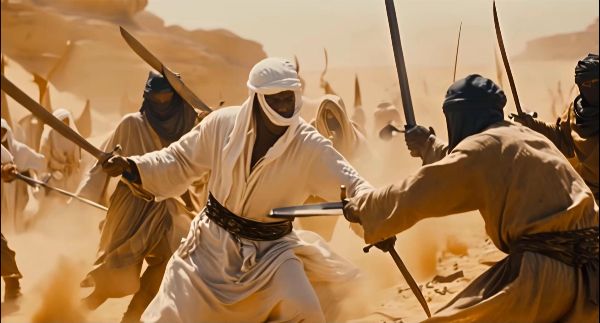
The battle began.
Confusion spread through Quraysh’s ranks. Fear replaced certainty. Discipline collapsed.
The Muslims advanced—not with numbers, but with resolve.
By the time the sun rose high, the battlefield fell silent.
Seventy from Quraysh were killed.
Seventy were captured.
Among the dead were men who had mocked, tortured, and plotted murder.
Abu Jahl was gone.
Umayyah ibn Khalaf had fallen.
The era of unchecked arrogance had ended.
Aftermath: Victory with Restraint
The Prophet (saw) forbade revenge.
Prisoners were treated with dignity. Some were freed for ransom. Others earned their freedom by teaching children to read.
Justice was measured.
Mercy was deliberate.
This was not conquest.
It was correction.
Conclusion: The Birth of a Nation
At Badr, the Muslims did not win because they were powerful.
They won because they were sincere.
They had no numbers.
No wealth.
No armour.
They had Allah.
And with that victory, the Ummah took its first true breath as a nation.
Badr would be remembered forever—not simply as a battle, but as the moment faith stood firm against arrogance.
The rise of a nation had begun.